Where the content theories focus on the question of 'what' motivates, the process theories address more the matters relating to how the process works and sustains itself over time, such as the aspects that determine the degree of effort, the continuation of effort, the modification of effort, etc.
As in content theory, there are number of process theories. These contain:
- Equity theory
- Expectancy theory
- The Porter-Lawler Model
Equity theory
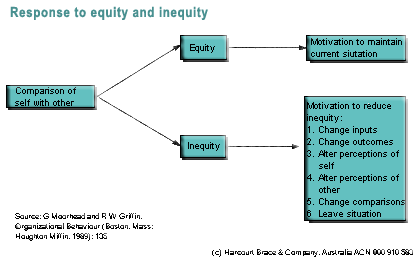
In this theory employee continuously assesses their level of effort in contrast to fellow workers and the reward they obtain for their effort. If they perceive there is a significant variance between their level of effort and their fellow workers, they will endeavor to bring about equality of effort for everyone—by adjusting up or decrease their own performance or by taking actions to adjust the level of their fellow workers. Similarly, the relative reward for effort is also monitored. The message for supervisors is that employees or workforce's need to be seen to be rewarded on a reasonable and equitable basis, and injustices quickly adjusted.
Â
Expectancy Theory
This is an important theory in the history of the study of motivation. This theory highlights that motivation is somewhat a decision-making process that assesses effort for outcomes. It highlights the participation of the active cognitive processes and user choice in the process. It also highlights the reputation of the outcome representing a valued return for the individual involved.
The actual evaluation process is divided into number of parts:
- If I put in effort, can I expect to perform at the required task?
- Will performing this act or task achieve a desired outcome?
- Can I expect the outcome will be available and forthcoming?
The Porter-Lawler Model
This model of motivation while based on the expectancy theory, is perhaps the most complete theory of workplace motivation. It is an integrated approach that contains elements of nearly all the other motivation theories. This is significant as it helps to explain why each of the several theories have a contribution to make but also serious limits. If we consider each as portion of a more complex model of motivation this starts to make sense.
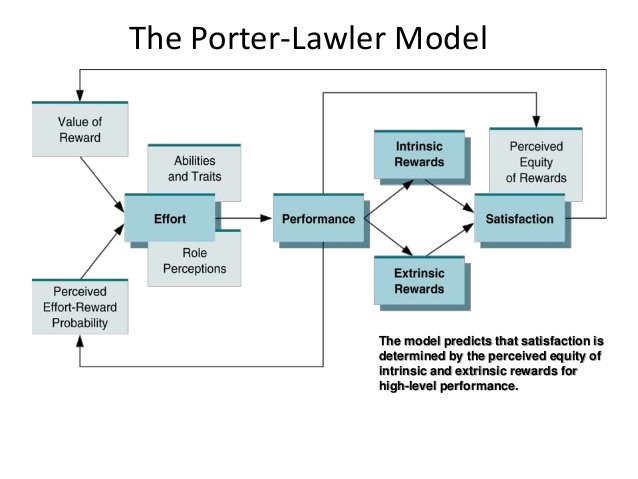
The model consequently suggests that using individual theories won't work. A further integrated approach is required. It also differs from content theories, mainly 'two factor' theory, in suggesting that performance leads to job satisfaction, relatively than job satisfaction leading to performance.
The complication
of the model, and the need to assess and provide valued rewards on an
individual basis, are practical restrictions. However, it is difficult to argue
with the process of the model. The area of motivation is complex and the model highlights this—rather than giving an unrealistically simple approach, as is the case with
many of the other theories.
February 05, 2017